
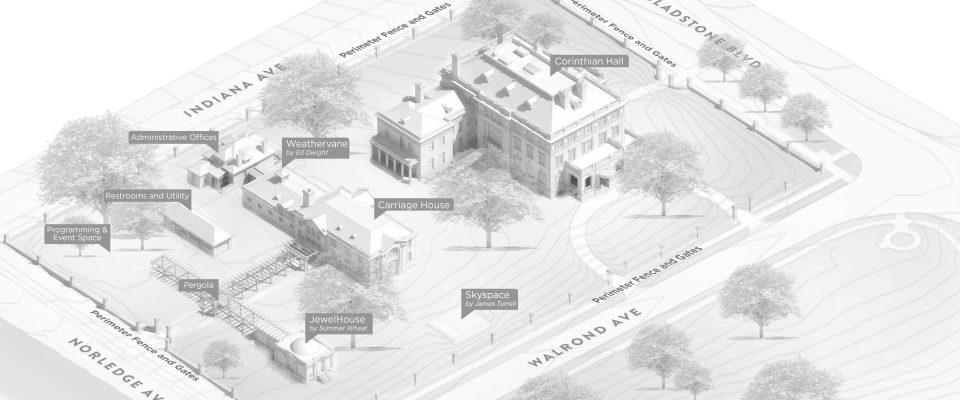



Since 2015, The Museum of Kansas City has been engaged in a comprehensive, multi-year restoration and rehabilitation of its entire 3.5-acre historic property. This transformative effort—known as Making A Museum KC—is a capital campaign designed to secure strategic funding to complete the renovation of the entire campus and its historic structures.
Stage I: Restoration & Rehabilitation of Corinthian Hall (Completed 2021)
In October 2021, the Museum reopened Corinthian Hall, the 34,000-square-foot former mansion of lumber baron R.A. Long.
- Architectural Design: International Architects Atelier (IAA)
- Exhibit Design: G&A
- Construction: JE Dunn Construction
- Exhibit Fabrication & Installation: Kubik Maltbie
The Stage I restoration and rehabilitation project cost approximately $25 million, funded through a combination of public and private sources, including KCMO voter-approved General Obligation Bonds.
Stage II: Continuing the Transformation
The Museum is currently collaborating with IAA and JE Dunn Construction to restore and rehabilitate the remaining historic buildings and structures on the property, including:
- Carriage House
- Lodge (former Horse Trainer’s Home)
- Conservatory (to become JewelHouse)
- Carpenter’s Shed
- Pergola
- Paddock Area
- Perimeter Fence and Gates
The Museum is also partnering with IAA to design new immersive experiences for the grounds, including a James Turrell Skyspace.
Recent Accomplishments
In 2025 and 2026, the Museum completed the following:
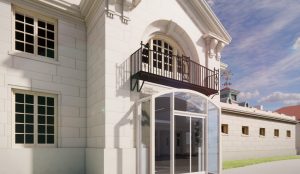
- Exterior restoration of the Carriage House
- Exterior and interior restoration and rehabilitation of the Lodge – the Lodge will be used as program and administrative space for the Museum and the Kansas City office of Missouri Humanities
- Art fabrication for JewelHouse – specifically the mosaic flooring
- Exhibit design for the Carriage House
- Critical sitework for future stages of construction
All of this work was funded through a combination of public and private sources, including funding from the State of Missouri. Future scopes of work will proceed as the Museum secures additional funding.
Historic Background
The Museum’s campus was originally the private residence of R.A. Long and his family, completed in 1910. The estate included:
- Corinthian Hall (mansion)
- Carriage House and Paddock Area
- Horse Trainer’s Home (Lodge)
- Garden/Carpenter’s Shed
- Conservatory with Pergola
- Greenhouse
- Perimeter Fence and Gates
In the early 1950s, the Conservatory was converted into a Planetarium, and by the 1960s, the Greenhouse was removed. The property became a public museum on May 5, 1940.
Click here to learn more and make a contribution.